Introduction
Sound is an essential part of the Ying Liuyue Nianshisi celebration.
The curatorial theme, Revival, invites visitors to discover the rich musical traditions that have long accompanied the festival.
Over the past century, countless sounds and musical traditions have echoed through the Ying Liuyue Nianshisifestivities:
Daban gongs and drums, Kailu drums, dragon drums, lion drums, sedan-chair drums, Zhentian drums...
Beiguan music of the Xipi and Fulu schools, Shiyin ensembles, Western bands...
Some of these traditions have disappeared over time. Many others, however, continue to thrive through the dedication of Daxi's Shetou organizations, whose members practice and perform year after year, bringing these sounds back to the annual procession.
The drum scores, gong-and-drum notation, Gongche notation, and Western staff notation preserved by these communities form the foundation of the Revival exhibition, celebrating a living musical heritage that continues to resonate across generations.
Author / Wu Min-Hui
The earliest known written record of the Ying Liuyue Nianshisi celebration appeared in the Taiwan Nichinichi Shimpo(Taiwan Daily News) in 1914. Between 1914 and 1927—a span of only thirteen years—around twenty Shetouorganizations were established in Daxi. This remains the most active and concentrated period of Shetou formation in the festival's history over the past century.
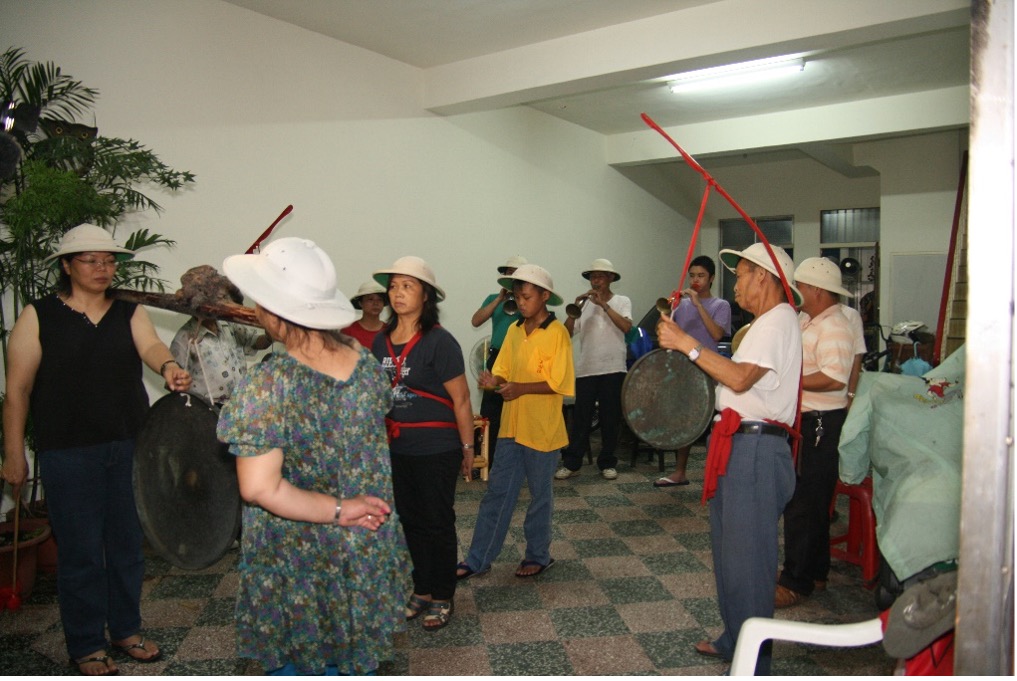
According to the late Mr. Jian Yuxi, whose oral history was recorded nearly twenty years ago, the Daban gong-and-drum ensemble, requiring only five performers, was likely the earliest form of ensemble music popular in Daxi before Beiguanmusic became widespread.
A typical ensemble consisted of one drummer, two suona players, and performers on gongs and cymbals. The drum was carried on the performer's back, while the gong was suspended for easy movement, making the ensemble especially well suited for religious processions through Daxi's narrow streets and alleys.
Apart from the suona, the rhythmic patterns for the gongs, drums, and cymbals were relatively straightforward. Mr. Jian recalled that anyone with a little musical aptitude could learn the repertoire in just a few days and join a procession. As a child, he even had the opportunity to perform with the ensemble himself.
From the Taishō era through the second year of the Shōwa era (1927), Daxi witnessed the most prolific period of Shetou establishment. Fifteen Shetou organizations founded during this era continue to exist today. At the time, each maintained at least one Beiguan ensemble, while the larger organizations trained enough musicians to field two performing groups simultaneously.
Music in Daxi extended far beyond instrumental performance. From the Japanese colonial period through the 1950s, many Shetou organizations also staged traditional opera performances as offerings to the deities. Skilled string musicians were especially abundant.
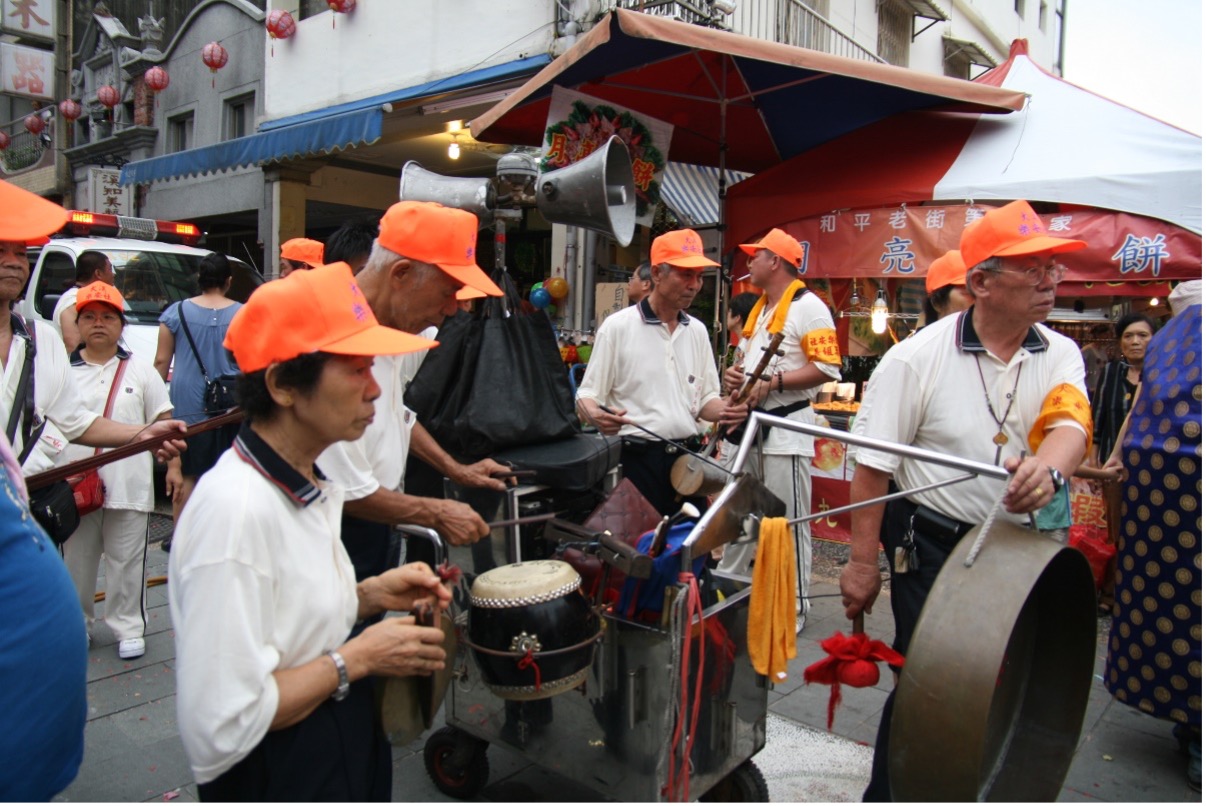
Ensembles centered on string instruments were known as Shiyin ensembles. Elder musicians explained that they performed the string repertoire of the Beiguan tradition. When fully staffed, a Shiyin ensemble could include more than ten different instruments—the term Shiyin, literally "ten sounds," reflects this rich instrumentation. Daxi's earliest Shetou organization, Le'an Society, was established as a Shiyin ensemble.
The names of Daxi's Shetou organizations also reveal their musical heritage. Most are called "Societies" (She), indicating their affiliation with the Fulu school of Beiguan. Traditionally, Fulu ensembles adopted the name She (Society), while ensembles of the Xipi school were more commonly known as Tang (Hall) or Xuan (Studio). Learning and performing Beiguan music was therefore not only natural but a source of pride. The name Lebin Society (樂豳社) in Touliao, for example, literally expresses a love for traditional music.
Unfortunately, the names of the Beiguan masters who taught during this period have largely been lost to history. Yet their remarkable teaching ability is evident: within the relatively small area east of the Dahan River in Daxi, they successfully trained musicians for more than a dozen Beiguan ensembles. The people of Daxi have always regarded celebrating Lord Guan's birthday with exceptional devotion, and the sight of more than a dozen Beiguan ensembles performing simultaneously in the annual procession stands as a powerful testament to that enduring faith.
While nearly every Shetou honored Lord Guan with Beiguan music, Dayou Society, whose members included many of Daxi's merchants and prominent families, sought to distinguish itself in a different way.
To establish a Western-style band, the society invited a music instructor named Wu Ben from Taipei to teach local musicians. Wu Ben was said to have performed for the Office of the Governor-General of Taiwan during the Japanese colonial era, making him an accomplished and respected musician.
Under his instruction, the society's young musicians mastered Western brass instruments, forming Daxi's very first Western band. During festival processions, they marched in immaculate white military-style uniforms and caps, performing with gleaming brass instruments polished to a mirror-like shine. Their appearance became one of the festival's most admired spectacles, drawing crowds of enthusiastic spectators along the arcaded streets.
The Dayou Society Western Band became the pioneer of Western ensemble performance in Daxi. Over the following six decades, more than six additional Western bands emerged, carrying forward the musical legacy it established.
The Daban Gong-and-Drum Ensemble of Zhenxing Society
Photo courtesy of Wu Min-Hui, 2009
Le'an Society Shiyin Ensemble
Photo courtesy of Wu Min-Hui, 2009
Taiwan Nichinichi Shimpo, July 23, 1926 (Taishō 15): Report on Dayou Society inviting music instructor Wu Ben from Taipei to teach in Daxi.



 1926-07-23_.png)




Facebook分享
Twitter分享
Line分享
複製網址分享